Why WiSERR Exists
The Crisis of
Tacit Knowledge
In an era of ubiquitous AI and exponential data, true mastery requires what machines lack: gut intuition, sensory judgment, and the tacit knowledge to navigate the unknown.
Executive Summary
The global landscape of 2026 represents a critical inflection point in the history of human cognition. As societies transition from the era of simple digitization to one defined by agentic automation and embedded intelligence, the fundamental nature of mastery is being redefined. At the center of this transformation is the “personal coefficient”—the subjective, experiential element of knowing that Hungarian-British polymath Michael Polanyi identified as the bedrock of all human understanding.
Read the full report here and explore the highlights below.
The Necessity of Mastery Across Society
This section explores why intuition is not just a luxury for the elite, but a fundamental requirement for survival and success across all levels of society. Select a persona below to understand how the ability to process tacit knowledge impacts their daily existence and future viability in an automated world.
Navigating Society & Employability
For the average person, gut intuition is the ultimate filter against manipulation in the modern economy. As consumers, they must sense the authenticity of products and information.
In the workforce, as AI automates routine cognitive tasks, the citizen’s value shifts from “knowledge retrieval” to “contextual judgment.” They need tacit knowledge to read a room, handle complex human interactions, and make decisions when data is incomplete or contradictory. Without this, they face severe economic displacement.
The Embodiment of Tacit Skill
The craftsman represents the pinnacle of physical and material intuition. Their knowledge resides in their hands and senses—knowing exactly when a material is ready, or feeling the precise tension required without looking at a gauge.
This somatic, deeply embodied knowledge is notoriously difficult to digitize or automate. In an age of mass-produced, algorithmic output, the craftsman’s intuitive mastery becomes a premium, irreplaceable asset that bridges the physical and digital divide.
Allostasis & Predicting the Unseen
For executives and board members, intuition is not about maintaining the status quo (homeostasis), but achieving allostasis—anticipating future needs and reconfiguring the organization before a crisis hits.
- Unmet Needs: Sensing market shifts before they can be quantified in analyst reports.
- Raw Talent: Identifying high-potential individuals whose intuitive capabilities don’t map neatly onto traditional resumes.
- Market Creation: Synthesizing disparate signals to conceptualize breakthrough features that create entirely new markets out of the void.
The Erosion of Sense and Judgment
Why are we losing our capacity for gut intuition? This section breaks down the systemic forces—both physiological and economic—that are degrading our ability to sense the unknown. By outsourcing our judgment to external systems, we sever the connection to our own tacit knowledge. Click on each systemic force to understand its impact
1. Sensory & Emotional Decline
The atrophy of internal biological signals required for deep judgment.
Gut intuition relies on interoception—the ability to sense internal bodily states (heart rate, gut feelings). Chronic stress, lack of emotional management, and over-reliance on screens blunt these sensory inputs. When we cannot manage our emotional baseline, we cannot hear the subtle somatic markers that guide complex, ambiguous decision-making.
3. The Surveillance Economy
Outsourcing navigation and choice to algorithmic guidance.
Just as the calculator eroded basic arithmetic skills, continuous surveillance and algorithmic recommendation engines (GPS, social feeds, predictive text) erode our navigational and social intuition. When an algorithm constantly tells us what we want, where to go, and who to talk to, the internal mechanisms for self-directed judgment atrophy from disuse.
2. The Extraction Economy
The commoditization of human cognition and behavior.
Modern economic models increasingly view human attention and behavior as raw resources to be extracted and predicted. By forcing humans into narrow, measurable KPIs, the space for unquantifiable tacit knowledge is squeezed out. Employees are discouraged from using intuition in favor of “data-driven” mandates, dulling their innate judgment muscles over time.
4. The Arousal Economy
Hijacking the nervous system with continuous dopamine loops.
The media and tech landscape prioritizes constant, high-arousal emotional states (outrage, extreme novelty) to capture attention. This perpetual state of fight-or-flight prevents the nervous system from entering the parasympathetic states required for deep reflection, pattern recognition, and the synthesis of tacit knowledge.
The Trigger: Why This is a Crisis NOW
The decline of intuition has been a slow burn for decades. However, a specific convergence of environmental shifts (the speed of information) and creative shifts (generative AI) has created an inflection point. The rate of human learning is linear; machine learning is exponential. This section visualizes the exact moment where reliance on explicit, documented knowledge fails, making tacit intuition our only remaining competitive advantage.
The Intersection of Capability
Cognitive processing speed and explicit knowledge mastery over time.
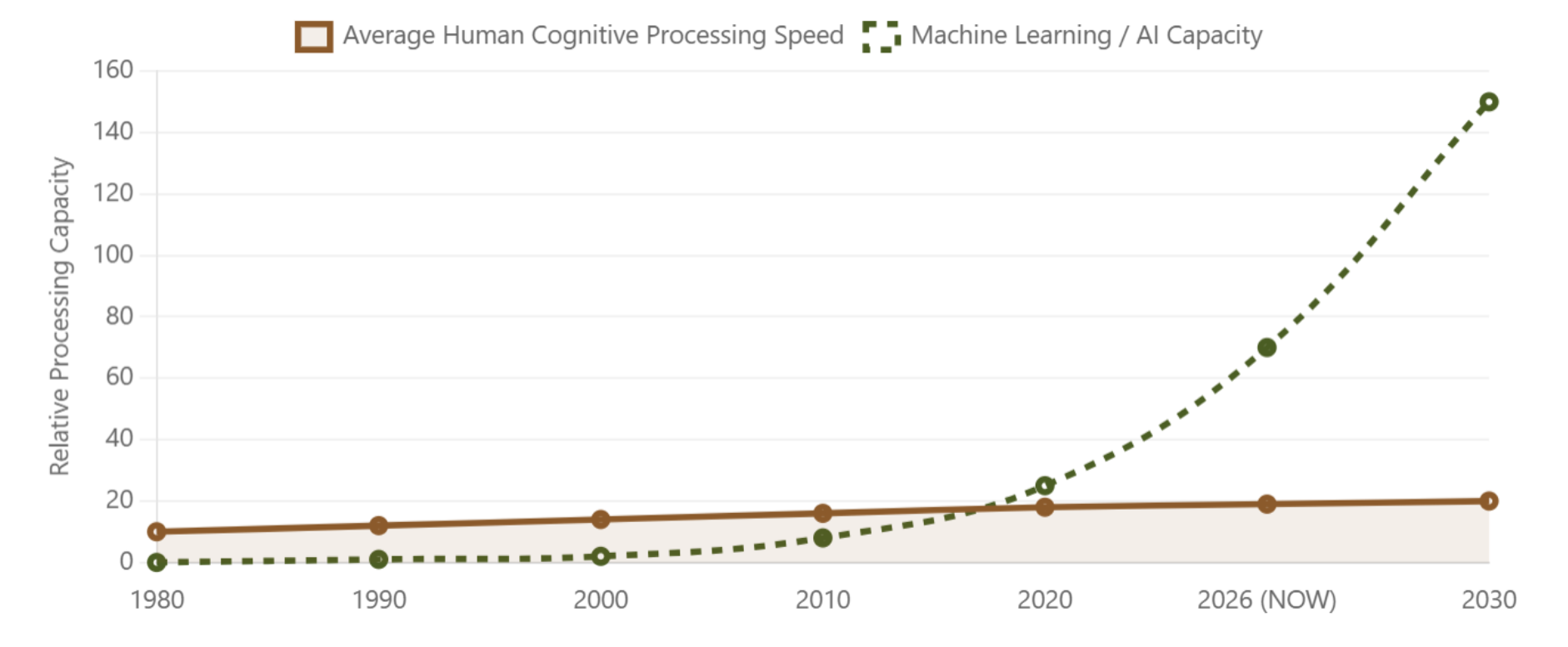
The Trigger Event: Right now, we are crossing the threshold where machine processing of explicit data surpasses average human capacity. Because machines handle the “knowns” instantly, human value is entirely pushed into the domain of the “unknowns”—a domain that can only be navigated via gut intuition.
The Shrinking Half-Life of Knowledge
The duration (in years) a learned technical skill remains relevant.
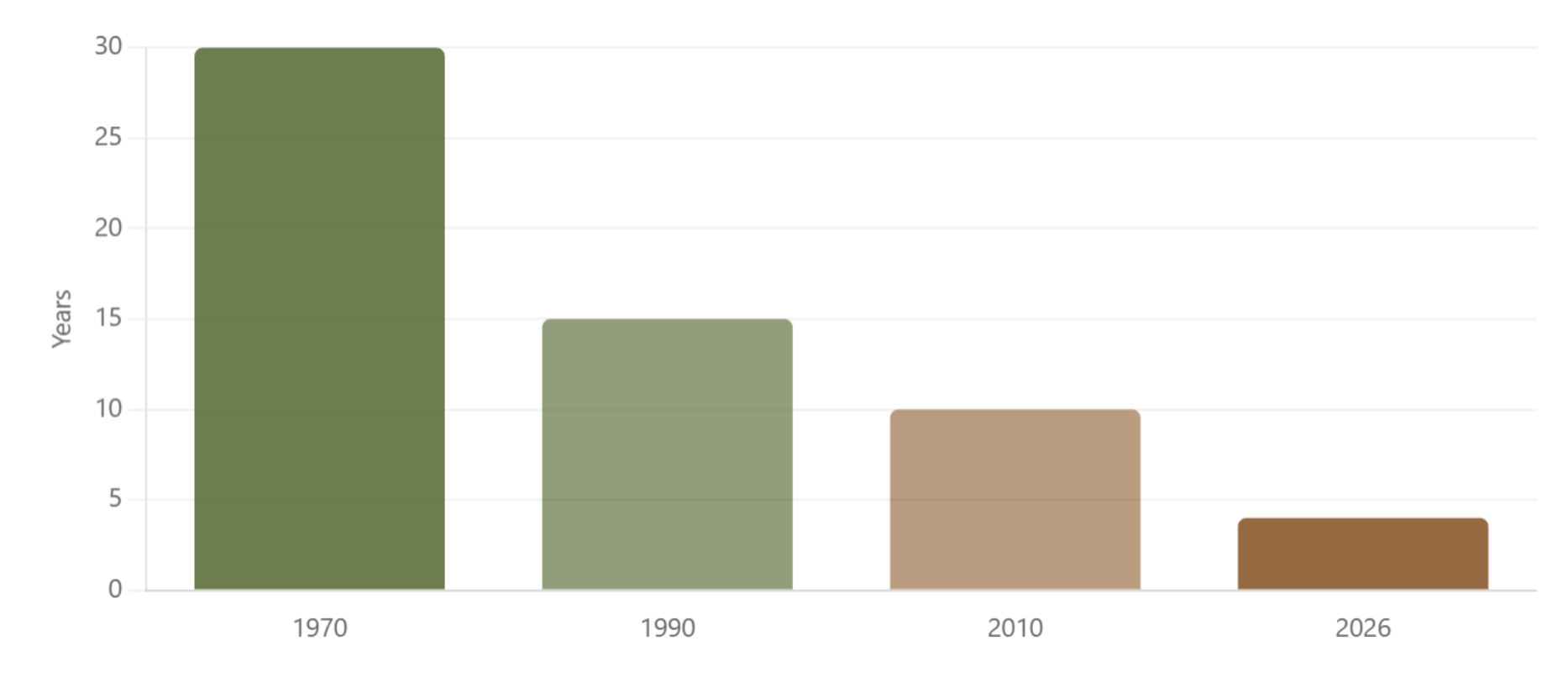
The Environmental Force: The rate of information transmission is now so fast that the half-life of learned, explicit knowledge has plummeted from decades to mere years. It is no longer possible for humans to “learn and remember” fast enough. Intuition—the ability to apply generalized wisdom to novel, unseen scenarios—is the only sustainable adaptation mechanism.
The Path Forward
Solving this crisis requires an active rebellion against the economies of extraction and arousal. We must intentionally rebuild our sensory and emotional management capabilities, cultivating spaces for deep, unstructured reflection. In the age of the algorithm, human intuition is not a relic; it is our ultimate frontier.